TANTHIM MOVE | ARCHITECTURE & TECHNOLOGY

An API-first architecture for regulated taxi operations

Tanthim Move connects booking channels, dispatch microservices, in-vehicle terminals and authority systems through versioned REST APIs and asynchronous trip events. Deploy in a sovereign cloud or fully on premises, with your authority controlling identity, access and data residency.

PLATFORM ARCHITECTURE

How the taxi ecosystem connects

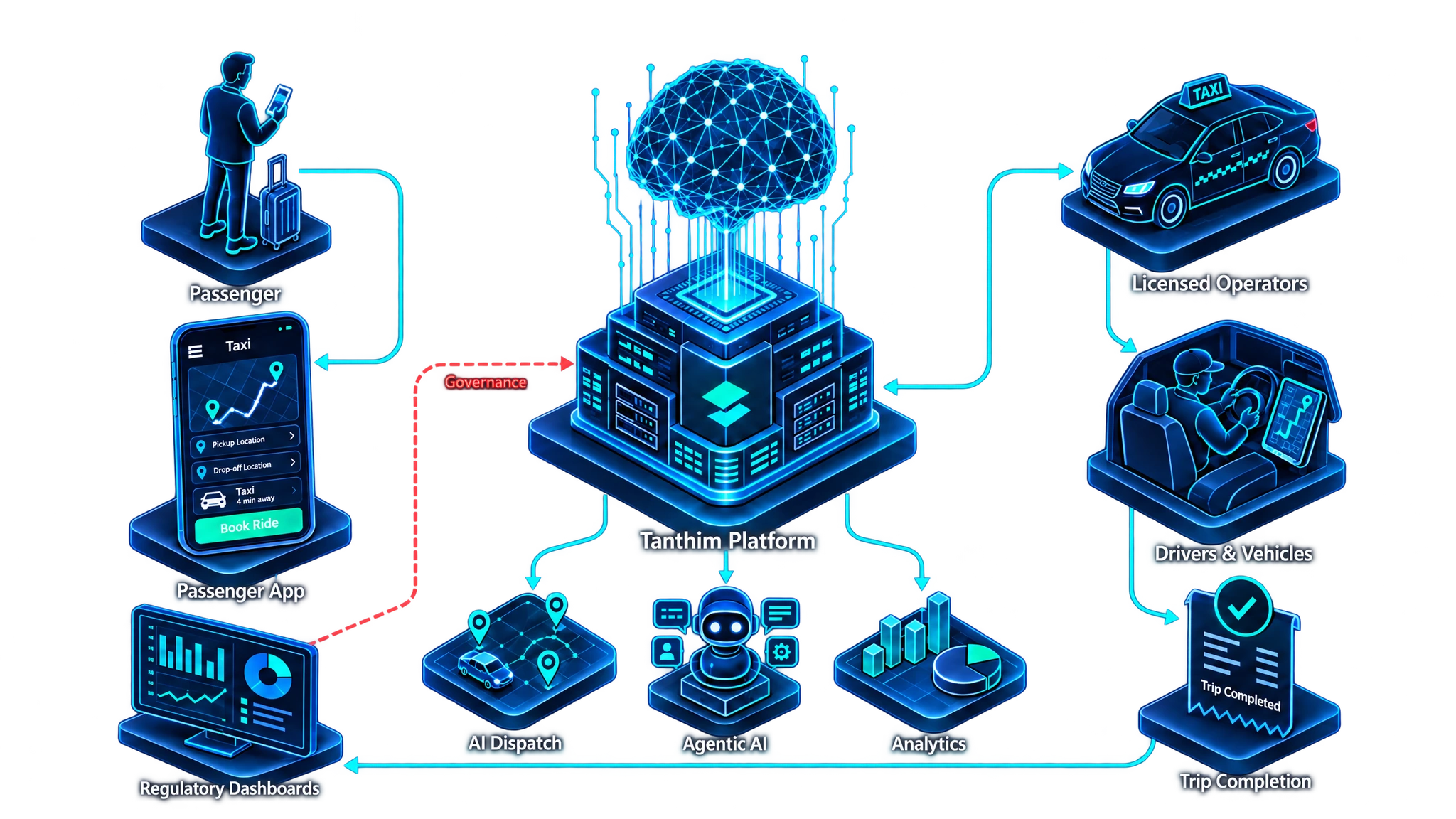
Passenger apps, kiosks and partner platforms submit bookings to the same dispatch services. Drivers and vehicles return trip events and telemetry. Fleet operators see their own operations, while the regulator can review service performance and policy decisions across licensed operators.

Tanthim Platform connects passenger booking, licensed operators, drivers and vehicles, regulatory dashboards, dispatch, AI and analytics.

CORE SERVICES

The services behind each trip

Booking and fare services maintain transaction records. The telemetry service handles frequent GPS updates. Dispatch brings the two together when a passenger requests a vehicle.

Booking & channel APIs

Versioned REST APIs expose fare estimation, booking creation, amendments, cancellation and trip status. Apps, super apps, kiosks and contact centres use the same interfaces. Webhooks return booking updates to subscribed channels.
Geospatial indexing & telemetry

An in-memory Redis geospatial index holds each driver’s latest coordinates and availability. Fresh GPS pings update the index. Dispatch queries nearby eligible drivers, while coordinates linked to an active trip contribute to its route record.
Dispatch & policy engine

Allocation rules combine proximity, vehicle class, accessibility requirements, zone eligibility and rank queue position. Configurable search radii, offer timeouts, retry limits and fallback rules govern which driver receives the next offer.
Event-driven trip lifecycle

Publish/subscribe messaging distributes assignment, arrival, pickup, completion and cancellation events. The dispatch audit records each offer and response, so an operator can distinguish time spent finding a driver from time spent reaching the passenger.
Tariffs & settlement

Versioned fare rules apply by booking channel, vehicle class, time window, toll gate and pricing zone. Component-level records support estimate-to-actual comparison, reconciliation and split settlement across participating operators and service providers.

AI in Tanthim & predictive modelling

Forecasting models combine historical trip patterns with current demand and available supply to identify potential shortages by zone. AI in Tanthim can query records within the user’s permissions, assemble supporting trip evidence and trigger a configured follow-up.

DISPATCH DATA FLOW

From GPS ping to confirmed booking

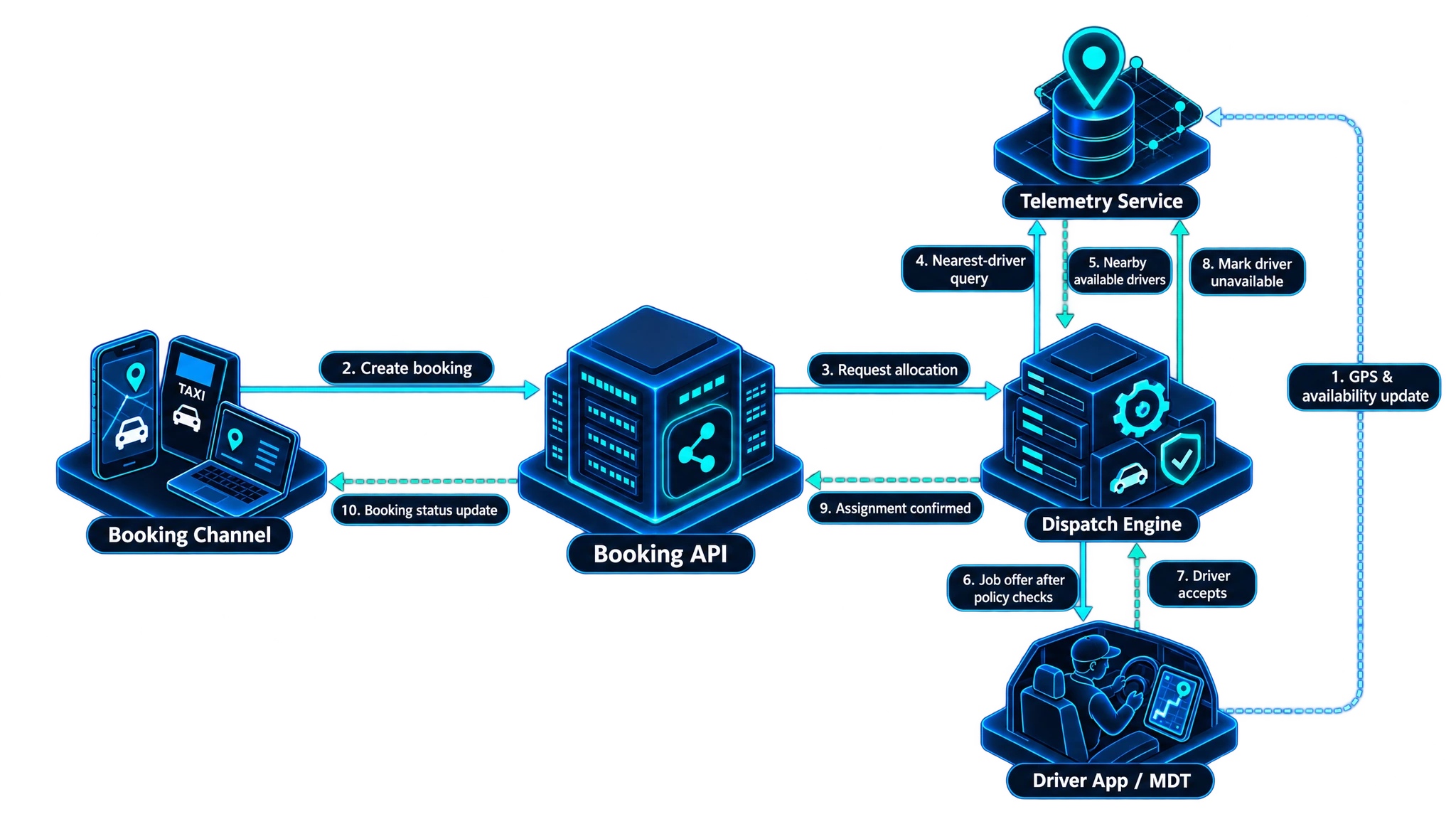
A driver’s location and availability determine whether dispatch can consider them. The booking’s policy rules determine whether they receive the offer.

The Driver App or MDT sends GPS and availability to Telemetry. The Booking Channel submits a booking through the Booking API. Dispatch requests nearby drivers, checks policy and offers the job. After acceptance, Dispatch marks the driver unavailable, confirms the assignment and returns the booking status to the channel.

Ingest

The driver device submits GPS updates. Fleet backends can send multiple positions through POST /api/v1/locations/batch-update.

Match

The telemetry service exposes GET /api/v1/locations/nearest for coordinate-based lookup. Dispatch applies the booking’s eligibility and allocation rules before issuing an offer.

Confirm

When a driver accepts, the trip service updates availability, removing the driver from subsequent available-vehicle searches. The booking channel receives the assignment and updated trip status.

INTEGRATION INTERFACES

Connect the systems already in service

Integrate at the passenger channel, fleet backend or vehicle, according to where each system produces and consumes data.

Passenger & transit systems

Booking APIs connect websites, super apps and shared mobility channels. Mobility as a Service (MaaS) and automated fare collection (AFC) integrations can connect the taxi leg with wider public transport journeys.

Fleet & authority systems

Exchange GPS positions, driver availability, trip status and compliance events. Batch ingestion supports operators with existing tracking devices. Role-scoped queries give fleet and authority teams access to the records they oversee.

MDTs & vehicle peripherals

Compatible Howen and Streamax Android terminals connect the vehicle to dispatch. Depending on the installation, inputs include meter pulses, odometer readings, ignition state and CAN bus telemetry. The MDT buffers accepted-trip events during coverage gaps and reconciles them on reconnection.

SECURITY & GOVERNANCE

Identity, access and audit

The platform checks who is calling, which records they can access and which actions an auditor can reconstruct.

Authenticate

Federated single sign-on (SSO) connects staff access to the authority’s identity provider. Driver APIs use JSON Web Tokens (JWTs). Location updates validate the submitted driver ID against the authenticated driver’s token.

Authorise

Role-based access control (RBAC) scopes fleet users to their operator, grants authorised regulators jurisdiction-wide visibility and supports read-only auditor access.

Audit

Dispatch attempts, policy versions, timestamps and named-user actions let investigators determine which rule applied and who acted. Exportable records support the authority’s retention and disclosure requirements.

DEPLOYMENT

Choose your deployment boundary

Define where operational records, telemetry, backups, audit logs and AI inference reside, and which integrations can cross the network boundary.

Sovereign cloud

Deploy in an approved in-country cloud environment. Map residency requirements across application services, data storage, backups and model inference.

Fully on premises

Run the platform in the authority’s data centre. Connect internal identity and operational systems, and use locally hosted AI inference where data must remain inside the authority’s infrastructure.